PoseViz
Demo
Documentation
PoseViz is a browser-based 3D visualization for pose tracking data recordings. Body tracking data, which can be gathered from infrared or stereoscopic depth sensors or estimated from normal 2D video feeds, is visualized as skeletons. It can be augmented with several optional inference visualizations, such as estimated gaze directions or projected walking trajectories.
This program was initially developed for the DFG-funded research project HoPE, which was concerned with the study of people’s behavior in front of large interactive public screens. When the HoPE research project began in 2021, we noticed fairly quickly that there were several different technological solutions for body tracking and pose estimation, but no vendor-neutral software or data format for storing and playing back recorded body tracking data. To remedy this gap, a custom file format for scene-based pose tracking data, also called PoseViz, was developed in tandem with this visualization software. It is loosely based on the Wavefront OBJ 3D model format and is relatively easy to intuit in a text editor. At time of writing, no tool to record/generate PoseViz files has been published, since in the course of the research project, they were deeply embedded in each sensor setup.
Scene-based body tracking data differs from typical skeletal animation data (e.g. BioVision Hierarchy) by being oriented around a fixed spatial context which actors may enter or leave over the course of a recording, instead of aiming to record one specific actor’s body movements. Nonetheless, BVH rendering support has been added to PoseViz for demonstration purposes.
With the end of project HoPE, development of PoseViz mostly came to a stop. When I left my then-employer in May 2026, we agreed that I would take the project with me and host it from this website. For that occasion, I worked on some improved demonstration-related features and long-postponed minor tweaks to make it more generally usable outside of our specific sensor setups. Rendering performance and frame rate accuracy were also improved. Unless a follow-up research project ends up emerging, this is presumed to be the finished state of PoseViz.
Poseviz_example
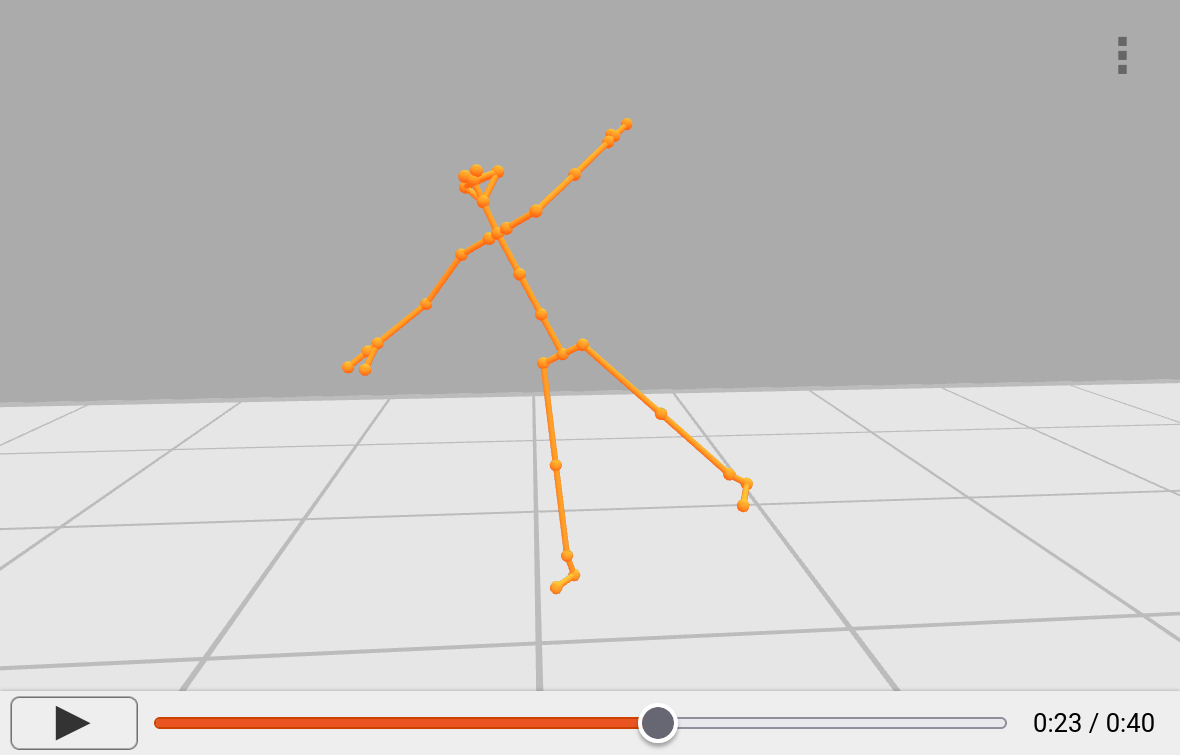
PoseViz was designed to resemble a web-based video player, with a play/pause button, a playback bar allowing for skipping, and timestamp output. Under the hood it renders a dynamic three.js scene.